A great site for those who love to hunt, fish, make sausage, cook, grill, and use that smoker!!

Picture yourself walking on a trail through stands of young aspen trees with blazing yellow leaves overhead. The fall air is crisp. Shotgun in hand, you’re enjoying a hike while hunting grouse-Minnesota’s most popular game bird. Something akin to this scene will soon be reality for the nearly 100,000 grouse hunters in Minnesota. The season for ruffed and spruce grouse runs from Saturday, Sept. 13, until Sunday, Jan. 4, 2015; and for sharp-tailed grouse from Sept. 13 to Sunday, Nov. 30.

Spring drumming counts were up 34% compared to 2013, possibly signaling the start of an upswing in the 10 year grouse cycle that since 2009 has been in the declining phase. However, brood rearing success may have been affected by a cold, wet spring. Grouse tend to be drawn to young forests where trees are less than a few inches in diameter, and they often are found on the edges of younger woods or the edges of trails where they can feed on clover and broad leafed plants.

There are 528 wildlife management areas in the ruffed grouse range that cover nearly 1 million acres, 43 designated ruffed grouse management areas and 600 miles of hunter walking trails. Search for hunter walking trails online at http://www.mndnr.gov/hunting/hwt. State forests, two national forests and county forest lands also offer many additional acres of public land for grouse hunting. Find public land on which to hunt by using the DNR’s Recreation Compass at http://www.mndnr.gov/maps/compass.html.

Grouse hunters usually use 12 or 20 gauge shotguns and No. 7 1/2 target or field loads. The daily limit for ruffed and spruce grouse is five combined, with a possession limit of 10. The daily limit for sharp-tailed grouse is three, with a possession limit of six. For more information on grouse hunting, see http://www.mndnr.gov/hunting/grouse. Have a safe and fun hunt.
The Minnesota DNR will auction confiscated hunting equipment on Sat. Sept. 20, beginning at 10 am. The auction’s items are from people who forfeited their equipment after committing serious game violations. The auction is open to the public. It will be held at Hiller Auction Service, 10785 261st Ave., Zimmerman. Sale items include confiscated firearms and bows. A list of firarms and bows for sale is on the auction website at; http://www.hillerauction.com/apr28.html.

Inspection of items is Friday, Sept. 19, from 8 a.m.to 5 p.m, and at 8 am, the day of the auction. Once the auction begins, there will not be any access to the firearms. All equipment is sold as is, including all defects or faults, known or unknown. Items cannot be returned once they have been purchased. Buyers may bring their own cases or there will be cases available for purchase to transport firearms. Anyone buying a firearm must pass a background check. Proceeds from the auction will be deposited in the state’s Game and Fish Fund, the fiscal foundation for much of Minnesota’s core fish and wildlife management functions.

I know I mentioned this before, but it don’t hurt to mention it one more time. Those who want to harvest antlerless deer throughout much of Minnesota this hunting season must apply by Thursday, Sept. 4, the Minnesota DNR said. Antlerless deer permits are issued by lottery. Many deer hunting permit areas that have not been in the lottery classification in recent years are in that classification this year. Deer hunters should review the hunting and trapping regulation book to see if their hunt requires entering a lottery to harvest antlerless deer.

Hunters who want to participate in special firearm deer hunts need to apply for permits that are issued by lottery; the application deadline is Sept. 4. More information on deer permit areas and special hunts in the DNR hunting regulations handbook, at http://www.mndnr.gov/hunting/deer.

Wolf licenses are also issued by lottery. Wolf hunters and trappers must apply by Sept. 4. Information on wolf hunting is available on the DNR website at http://www.mndnr.gov/hunting/wolf. Wolf management information is available at http://www.mndnr.gov/wolves.

53e0ef663f630.image

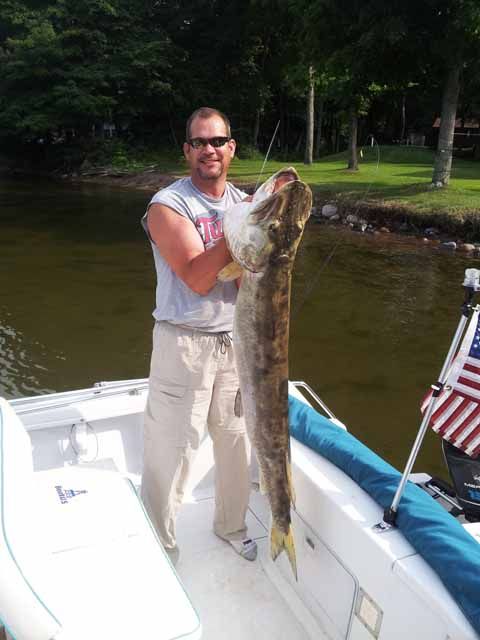
Dan Perron, a former conservation officer for the Minnesota DNR office in Onamia, spotted a 58 1/2 inch muskie, with a girth of over 25 inches, dead on July 20th. Out walleye fishing with his wife, Paula, Perron spotted the fish while cruising from one fishing spot to another. Fifty yards one way or another, Perron said, and he would have missed it. ” We were just past 4 mile,” said Perron. ” The wind was out of the south, blowing the fish out into the lake.”

The eyes and gills were still intact, leading Perron to believe the fish hadn’t been dead long. ” The teeth were ground all the way down,” said Perron. “And some of the skin was a bit flabby. It likely died of old age.” The former conservation officer and Navy man had to make a decision as to what to do with the muskie.

The former conservation officer and Navy man had to make a decision as to what to do with the muskie. “For being in that lake that long, not being caught, it deserved to be back out there,” said Perron, who said he blew his boat’s horn and saluted the fish as it floated away from his boat. A Proper burial. The fish of a lifetime-Perron said at one time it was no doubt a state record- had a head on it nine inches across.

After seeing the monster, Perron believes there’s likely another one just like it- alive and swimming in Mille Lacs–because of the amount of forage and the sheer size of the lake and areas which aren’t fished. So, for now, the state record muskie still stands at 54 pounds. That fish was 56 inches in length and had a 27.25 inch girth. It was caught on Lake Winnebigoshish in 1957.

St. Croix State Park in Hinkley will pilot an archery hunt for part of the 2014 fall deer season. The archery hunt will be Sept. 29 through Nov. 7, with the exception of Saturday, Nov. 1 and Sunday, Nov. 2, when the park will close for a youth firearms hunt. One hundred archery tags will be available; the deadline to apply for them is Aug. 15.

After a 2011 storm downed trees and dramatically changed the landscape, the number of rifle hunters allowed in the park was reduced for safety reasons. The archery hunt is being added to help safely maintain a healthy deer herd while allowing the park’s pine trees to regenerate. Deer like to browse on the buds of immature pine saplings, which damages trees and stunts their growth. Consequently, when there are too many deer in an area, pine trees often struggle to reach maturity.

To apply for the fall archery hunt, hunters should write their name, street address, email address and telephone number on a postcard and send it to St. Croix State Park, 30065 St. Croix Park Road, Hinckley, Mn 55037. Hunting parties of up to four people can apply together by putting each applicant’s contact information all on one card. The park plans to allow one additional antlerless tag per hunter for the archery hunt, as well as the normal either-sex archery tag. Successful applicants will be notified by Aug. 22. Any questions regarding the hunt can be directed to the park headquarters at 320-384-6591.

Construction of a six-mile paved trail segment connecting the Paul Bunyan State Trail to Crow Wing State Park in Brainerd is now complete and open to the public, according to the DNR Parks and Trails Division. The completion of this segment brings the total length of the trail to 116 miles, not including a couple of short on-road connections through the cities of Baxter and Bemidji. Extending all the way to Lake Bemidji State Park, north of Bemidji, it is the longest of Minnesota’s 25 state trails and the longest continuously paved rail-trail in the country. In 2011, the Rail-to-Trails Conservancy bolstered the trail’s growing national reputation by naming it to the Rail-Trail Hall of Fame.

An aerial video of the new trail segment-created by the contractor, Anderson Brothers Construction Company of Brainerd-is posted on You Tube at http://youtu.be/cIN-ObQm9OU .

Northeastern Minnesota hunters will feel the greatest impact from a bucks-only season. In bucks- only areas, no antlerless deer may be harvested by any hunter, including those with archery or youth licenses. Most of these areas are now below goal and that this year’s conservative approach is consistent with the DNR’s long-term commitment to manage deer populations at established goal levels.

It’s been many years for me since I have seen a bucks-only season. I’ve seen many good years up north where I hunt and a few years when no venison came home. We have had a couple of severe winters in the Arrowhead area of Minnesota. Last winter was one of the worst I have seen with the heavy snow and bitterly cold temps. I believe those conditions affected the deer herd in a negative way for sure.

However, firearms deer season is more than bringing home the venison or maybe a trophy buck. It is to be with good friends and enjoy what the outdoors have to offer. Always good times and many memories. I hunt in area 180. I’ll go up to my area in the fall to scout the area and check for signs. Hopefully we have some “normal” winters for a few years and get that herd back up there. Here is the site you want to go to to check for the 2014 regulation and the information for your area http://www.mndnr.gov/hunting/deer/index.html  .

New trout fishing regulations that took effect July 14 expand oportunities for anglers and simplify regulations in southeastern Minnesota, the DNR said. The regulations extend catch and release seasons in eight southeastern Minnesota counties and seven trout streams in Minnesota state parks. Barbless hooks are no longer required. And beginning Jan. 1, 2015, southeast Minnesota streams are open in winter to cacatch and release trout fishing.

“The new regulations make trout, fishing more accessible and easier to understand,” said Brad Parsons, central region fisheries supervisor. “Anglers will be able to catch and release trout for more of the year and in more streams.” Southeastern Minnesota counties included in the regulations are Dodge, Fillmore, Goodhue, Houston, Mower, Olmsted, Wabasha and Winona. If anglers plan to fish for trout, they need to check to see if there are any special regulations, including slot limits and required use of artificial lures and flies, for the stream where they plan to fish.

In state parks, the regulations include the following waters: East Beaver Creek in Beaver Creek Valley State Park; Forestville Creek in Forestville/Mystery Cave State Park; Canfield Creek in Forestvill/mystery Cave State Park; South Branch Root River in Forestville/Mystery Cave State Park; Trout Run Creek in White water State Park and Middle Branch Whitewater River in Whitewater State Park.

2014 Trout Seasons

In southeastern Minnesota, the fall catch and release season on trout streams has been extended. The season starts Monday, Sept. 15 following the end of the currently open harvest season and runs through Wednesday, Oct, 15. The harvest season is the period during which anglers may keep trout.

The Manitoba government says its experiment to eradicate a zebra mussel invasion in Lake Winnepeg appears to be successful, at least in one of its harbors. Officials say Winnipeg Beach will be reopened after it was closed two weeks ago. The harbor was one of four that was sealed off with a silt curtain and pumped through with liquid potash until it reached a lethal concentration for the mussels.

Rob Nedotiatko, who coordinated the treatment, says test mussels in a nearby secure cage have all died. “The gated curtain at the mouth of the harbor was removed, officially signifying the end of the treatment process,” Nedotiatko told reporters Monday afternoon. “It was determined late yesterday that all test zebra mussels in the harbor; through mortality testing, were confirmed dead.”

Because the mussels in the cage died, officials are assuming the ones not in the cage are dead as well. Nedotiatko said so far, the signs are promising for the harbors at Gimli, Balsam Bay and Arnes. The potash treatment began at Balsam Bay on May 24th and at Gimli Harbor on Saturday, while a curtain is currently being installed at Arnes. The province says the liquid potash treatment in open water, in a lake environment, is the first of its kind.

Talk about a frying pan-sized panfish! According to the Arizona Game and Fish Department, a pending world-record redear sunfish was hauled out of Lake Havasu, weighing in at a whopping 5.78 pounds, and breaking the previous record of 5.55 pounds.

Hector Brito targeted the chalk cliffs area of the lake and expected to see a catfish on the end of his line when his dropshot rig fixed with a no. 8 aberdeen hook and baited with a plump nightcrawler was inhaled. Redear sunfish, aka shellcrackers, in Lake Havasu grow to enormous proportions as they feed on the invasive quagga mussel. Most experts and local anglers believe that redears over the 6 pound mark exist in the lake.

recordsunny