A great site for those who love to hunt, fish, make sausage, cook, grill, and use that smoker!!

Minnesota’s ruffed grouse spring drumming counts were significantly higher than last year across must of the bird’s range, according to a survey conducted by Minnesota’s DNR.  “Ruffed grouse drums increased 343 percent from the previous year, with the increase happening in the northern part of the state,” said Charlotte Roy, DNR grouse project leader.  “This may signal the start of an upswing in the grouse cycle that since 2009 has been in the declining phase.”  The increase is consistent with changes typical of the 10 year grouse cycle.  The most recent peak in drum counts occorred in 2009.  The cycle is less pronounced in the more southern regions of the state, near the edge of the ruffed grouse range.

Drumming counts are an indicator of the ruffed grouse breeding population.  The number of birds present during the fall hunting season also depends upon nesting success and chick survival during the spring and summer.  Minnesota frequently is the nation’s top ruffed grouse producer.  On average, 115,000 hunters harvest 545,000 ruffed grouse in Minnesota each year, also making it the state’s most popular game bird.  During the peak years of 1971  and 1989, hunters harvested more than 1 million ruffed grouse.  Michigan and Wisconsin, which frequently field more hunters than Minnesota, round out the top three states in ruffed grouse harvest.

one reason for Minnesota’s status as a top grouse producer is an abundance of aspen and other ruffed grouse habitat, much of it located on county, state and national forests, where public hunting is allowed.  An estimated 11.5 million of the state’s 18.3 million acres of forest are grouse habitat.  For the past 65 years, DNR biologists have monitored ruffed grouse populations.  This year, DNR staff and cooperators from 11 organizations surveyed 121 routes across the state.

Sharp-tailed grouse counts were higher in 2014 than in 2013, although changes were not significant at the regional level.  However sharptail populations have declined in some areas as a result of habitat deterioration.  In recent years, the DNR has increased prescribed burning and shearing that keep trees from overtaking the open brush lands that sharp-tailed grouse need to thrive.  This habitat management is important for healthy sharp-tailed grouse populations.
Heavy rains in portions of northern Minnesota have prompted the closure of some off-highway vehicle [OHV] trails and state forest roads, the Minnesota DNR said.  Some forest roads and OHV trails are flooded, are unstable due to soil saturation or have washed out in sections, so several have been temporarily closed to the public and signed at entry points.

Kabetogama, Koochinching, Land O’Lakes and St. Croix state forests are some of the impacted areas.  State forest road and trail users should check ” Current Conditions” on the DNR website at http://www.mndnr.gov/trailconditions/index.html  before traveling.  Road and trail closing information will be updated as conditions change.

“By checking the conditions online, trails users should be able to find alternative locations where they can still get out to enjoy the trails, ” said Joe Alberio, a district supervisor for the DNR’s Parks and Trails Division.  ” The road and trail closures will be lifted as soon as conditions allow and repairs are made, and we ask everyone to ride responsibly wherever they are.”

I got this from Facebook from the North American Hunter.  Found it very interesting.  Guess when we walk in the woods we should breath less LOL.  Here is the story:  Calvin Wakefield an intern, helped monitor how many ticks were in a whitetail bedding area on property near Branson, Missouri, by walking through it while wearing white pants.  Calvin collected 100 plus ticks in only a few minutes!

If Calvin’s tick collection exercise causes you to start scratching under your pant leg, then the next experiment will probably give you nightmares.  He put dry ice in a container and then placed it in the same deer bedding area he walked before. The container sat in place for just under 8 hours.  Ready for some weird science?  Ticks are attracted to dry ice because as it melts it releases carbon dioxide [CO2} , which is what mammals [sources of blood meals for ticks] exhale.

In other words, it’s what mammals [like you] exhale that primarily attracts ticks, not body heat or body odor.  So the gas produced by dry ice melting is like a loud dinner bell to ticks.  Using masking tape, Calvin  captured 667 ticks that came to less than 1 pound of dry ice.  Keeping this in mind, imagine how many ticks would come to get a blood meal from a newborn whitetail fawn that barely moves for days in the same bedding area where he placed the dry ice tick trap.

I hunt in northern Minnesota and I’ve hunted there since the 60’s.  In all the years of hunting up there in the fall into firearms season I have had only a few ticks on me over the years.  However living down here in the Metro area I have had a lot more, with an increasing amount of deer ticks that I have noticed.  So check yourself out after returning from a day outdoors.

I have seen these outbreaks a few times over the years.  Sometimes there is little damage to  the trees and there are times they are all over with vast amounts of trees being defoliated. According to the Minnesota DNR the forest tent caterpillar population has been on the rise in some northern and west-central Minnesota counties since 2007, but may have reached a peak in 2013 when 1.1 million acres of aspen, oak, basswood, birch and other hardwood trees were defoliated.

Minnesota’s native forest tent caterpillars, sometimes called army worms, have outbreaks every 10 to 16 years.  “Based on historic trends, we would have expected the population to reach a peak this year or next year, but have found few egg masses in recent surveys of last year’s infested areas,” said Mike Albers, DNR forest health specialist.  “We also found up to 90 percent of forest tent caterpillar cocoons in our sample plots were killed by a native fly, which is more than we expected to be killed at this point in the outbreak.”

It’s still too early to tell if the forest tent caterpillar population is declining.  If population increase as normally expected, areas in Minnesota that saw large number of caterpillars last year could have even larger numbers this year, and portions of the state that had fewer caterpillars could also expect to see more.  However, based on the results of the egg mass survey this spring, it’s difficult to predict what will happen with forest tent caterpillar populations and the impact they will have this summer.

More information about forest tent caterpillar indentification, impact, management or local predictions can be found at http://www.mndnr.gov/treecare/forest_health/ftc.

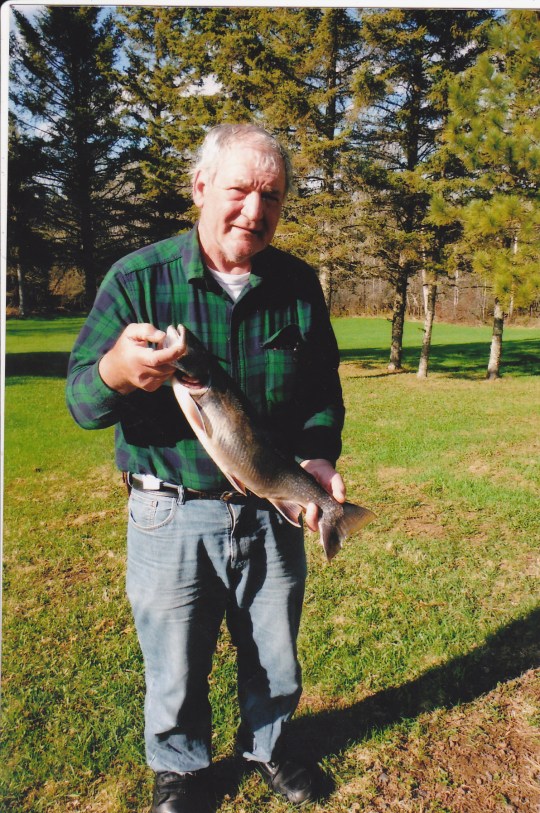
Ed's  Trophy  Brook  Trout

My brother sent me the pics of the large brook trout [coaster] he caught north of Grand Marais Minnesota. The fish weighed in at 5 pounds. These brook trout [also known as Coasters] are lake run brook trout and found only on the upper part of the North Shore and up into the Canadian coastal region of Lake Superior. The large brook trout was caught on a spawn bag drifted near the mouth of a stream fishing for steelhead.

Reminders

Remember that this weekend, June 6 trough the 8th is Take a Kid Fishing Weekend.  During this three-day period, Minnesotans age 16 or older do not need a fishing license while taking a child age 15 or younger fishing.

Muskie season opens Saturday, June 7th.  Exciting time for many anglers for sure.  Minnesota is on of the top places to go to get that trophy muskie.  People come here because they have the chance to catch a giant muskie.  Muskie anglers are more than happy to cast all day long and not catch a fish, but if they get the chance to see one of those fish follow their lure to the boat-that’s all they talk about for the next two weeks.

For these reasons, some circles of muskie anglers even refer to themselves as muskie hunters.  The chance to catch a trophy is what led the Minnesota Muskie and Pike Alliance to support a 54inch minimum size limit, which was adopted into this year’s game and fish bill, and will become effective with the 2015 muskie season.

What will be the result? The change likely will allow fish to grow larger, said Mike Habrat, DNR fisheries specialist in Detroit Lakes. Until the new size limit goes into effect, the statewide minimum size is 48 inches.  The length limit makes exceptions for muskie-northern pike hybrids, also called tiger muskie, in the seven county metro area, where the minimum size limit remains 40 inches on certain lakes.

Minnesota’s rise as a renowned muskie fishing destination is the result of research that identified how best to capture and rear a large-growing native strain of muskie, stocking this strain in appropriate waters, and managing the harvest.  The new size length regulation will help the state continue to be a destination for those seeking large muskie, Habrat said.  According to information compiled by Muskie, Inc.  Magazine and The Lunge Log, three of the nations top five muskie lakes [based on reports of 50-inch fish or larger] are located in Minnesota and 11 of the nation’s top 19 muskie lakes are located in Minnesota.  Lakes like Vermillion, Mille Lacs and Big Detroit are commonly recognized as among the best in the country for catching big muskie.

How many life jackets do I need in my boat, and am I required to wear one?

A readily accessible U.S. Coast Guard-approved life jacket is required for each person on all boats including canoes, kayaks and stand-up paddleboards.  A Type IV throwable device is also required on boats more than 16 feet.  Children under 10 years old must wear a life jacket while a boat is underway unless the child is in an enclosed cabin, aboard a passenger vessel operated by a licensed captain, or on a boat that is anchored for the purpose of swimming or diving.  The life jacket also must be the appropriate size for the wearer.  Kara Owens, DNR boat and water safety specialist.

OUR  BEAUTIFUL GRANDCHILD IS  BORN

My daughter Kim and her husband Erick had our 5th grandchild last Friday morning. What an exciting time for all of us. God has blessed us with the birth of Grace!!! Six pounds and one ounce and almost a full head of hair. Makes for a full house here and we are happy for it.

My brother Ed, was up in the Grand Marais area last week and caught his personal best brook trout.  23  inches long and 5 pounds.  Brook trout caught near the mouths of the streams in that area are also known a Coasters.  They spend most of their  time in Lake Superior.  They spawn in the fall, so I think this one was in the river eating the spawn of the steelhead and loopers during their spawning run.  My brother caught the huge brookie on a spawn bag under a strike indicator [bobber].  Ed said ” until I saw the orange deep purple fins, I thought I was fighting a steelhead”.

He also said that he managed to get two clipped and dark fish north of Grand Marais.  Rainbows and Steelhead in all the rivers.  Saw one of the biggest Steelhead, well over 10 pounds spawning with a couple of smaller 5 to 6 pounders in a pool below highway 61.  Some of the action was withing 20 milies north of Grand Marais.  That was supposed to be his last trip up there but Ed said he is going up again next week for some more.  So if anyone is planning to go up to the north shore this week, go to the upper north shore.  North of Silver Bay to the border.

Chad Wentzel landed a record 4 pound golden redhorse on May 8 from a bank of the Root River in Fillmore County, the Minnesota DNR confirmed.  Wentzel was fishing using 6 pound test line.  He pitched his worm presentation, leaving the bait on the river bottom until he hooked into the record breaker, which bested the previous record by one ounce.

Recent  Record  Breakers

Ben Ranzenberger of Winona bested the past record warmouth while ice fishing on Dec. 23, 2011, in Bartlet Lake on Pool 6 near Winona.  His fish weighed in at 9 oz.

Fred Draeger of Wabasha smashed the current bowfin record of 11 pounds 4 oz by a whopping 1 pound, 5 oz. on Sept. 14, 2012, when he caught 12 pounds, 9 oz. worth of fighting fish.  Fred caught the fish on a gob of nightcrawlers in the backwaters of the Mississippi on 8 pound test line.

Nicholas Nutter of Chaska landed a river carpsucker on Nov. 19, 2012, that weighed an impressive 4 pounds, 6 oz. and had a girth of 21 5/6th inches.  His record was caught on the Minnesota River with a jig and ringworm combination and bested the previous mark by 7 ounces.

Aaron Guthrie of Bemidji caught a burbot weighing in at 19 pounds, 8 ounces on Feb. 24, 2012, on Lake of the Woods, beating the previous record of 19 pounds, 3 ounces. Guthrie was using a fathead minnow on a tip-up. Guthrie was targeting burbot- also called eelpout- for its flavorful white meat.

Sarah Gartner of St. Paul hooked into a shovelnose sturgeon that tipped the scales at 6 pounds, 7 ounces just south of the Red Wing dam Feb. 19, 2012, on the Mississippi River.  Gartner was using a multi-colored jig and a minnow to score this new state record  Congratulations to all these anglers!!


Looking to spend some quality time with a kid?  Consider Take a Kid Fishing Weekend.  Minnesotans ange 16 or older do not need a fishing license while taking a child age 15 or younger fishing from Friday, June 6 to Sunday, June 8, according to the Minnesota DNR.  This is a great opportunity for adults to take kids fishing without purchasing a fishing licence.  We need to get the kids involved not only in fishing but the outdoors in general.  Here is something more from the DNR:  To start, see the DNR’s Fish Minnesota page at http://www.mndr.gov/fishmn,which includes;

Answers to basic fishing questions.

Fishing terminology and a beginner’s guide to fishing.

Metro fishing spots, family-friendly settings, pier locations and places to borrow fishing gear.

Got other plans from June 6-8? Even when it’s not Take a Kid Fishing Weekend, Minnesota residents generally can fish in state parks without a fishing license if the body of water doesn’t require a trout stamp.  For more information, see http://www.mndnr.gov/state_parks/fishing.html.  For those new to  fishing, guidance can sometimes help.  Kids fishing classes from the DNR’s I Can Fish!  program run throughout the summer at state parks.  For details, see http://www.mndnr.gov/takeakidfishing.

Wonder where  Minnesota’s loons spend the winter?  Well Minnesota’s loons primarily spend their winters in the Gulf of Mexico offshore from Alabama and the Florida panhandle, and southward along the Florida Gulf Coast.  Every year I can’t wait to hear the loons when I’m out in the outdoors.  Camping and lying in my sleeping bag at night, the sounds they make are incredible.  Looking forward to seeing them next time i’m out on the water.